Featured Review
“Great skilled guy with lots of experience, completed the project exactly as I expected. I will come back with more projects”

Boi Boi
Entrepreneur | Vietnam
Since 2020, I've been helping startups and agencies turn ideas into reliable Android and full-stack products, from mobile apps and web platforms to APIs, dashboards, and backend systems.

Monjel Sabbir
Android & Full-Stack Software Engineer
Focus
Clean products
Delivery mindset
Reliable & polished
Projects Completed
Happy Clients
Years Experience
Technologies
Collaborating with innovative startups, agencies, and teams worldwide to deliver high-quality digital products.
“Great skilled guy with lots of experience, completed the project exactly as I expected. I will come back with more projects”
Entrepreneur | Vietnam
“Sabbir did an amazing job turning my website into a mobile app. I'm really pleased with his quick and great service. His kind demeanor made the process go well. I strongly suggest him for his effective work, and I look forward to collaborating with him on more projects.”
Companies & Partners

Telecommunication Company

Internet Service Provider Company

Storelocal® Storage Locally Operated in USA
A focused selection of mobile and web products built for real business needs.
High-impact development services designed for international startups, agencies, and product teams.
Java and Kotlin applications, Firebase integration, API development, Play Store delivery, bug fixing, and existing-app modernization.
Next.js, React, Node.js, dashboards, authentication, databases, payments, and business-management systems.
Short development sprints for agencies and startups that need bugs fixed, features completed, or delayed projects delivered.
My professional journey and the teams and companies I have worked with.
October 2021 – Present
Founded MMS Studio to design, develop, and deliver mobile applications, web platforms, digital products, and custom software solutions for local and international users. I manage the complete product lifecycle, from planning and UI design to development, payment integration, automation, deployment, and ongoing maintenance. Through MMS Studio, I have launched multiple Android applications and built practical digital solutions using Android, Java, Firebase, Next.js, Node.js, PHP, and cloud technologies.
October 2025 – July 2026
Contributed to frontend development, maintenance, and quality assurance for client projects. Built responsive, reusable interfaces from design and business requirements, resolved UI issues, integrated frontend components with backend APIs, and collaborated with the development team to deliver reliable production-ready features.
March 2025 – July 2025
Led the development and maintenance of AirLink BD’s ISP management system across its mobile application, website, and backend services. Built and supported operational features while prioritizing secure server-side access, role-based workflows, and reliable data handling.
May 2024 – September 2024
Managed day-to-day business operations, coordinating sales, customer service, inventory, and administrative activities to support smooth and reliable operations.
October 2019 – June 2021
Led management for TSB E-sports, securing and managing sponsorships, organizing online tournaments, and coordinating collaborations with external organizations. Planned and delivered initiatives from initial coordination through execution, helping ensure smooth events and productive partner relationships.
Proven expertise across modern web, native mobile, backend systems, workflow automation, and development tooling.
Native mobile and modern frontend product development
APIs, databases, authentication, storage, and deployment
Workflow automation, AI agent integration, and infra tunneling
Supporting frontend frameworks, state management, and web technologies
Development, version control, collaboration, and design workflow
Detailed feedback and recommendations from team leads, clients, and technical managers.
He delivered what it was asked. Great guy. Easy to communicate creative and great understanding. I would highly recommend him. Excellent developer with good knowledge with his works. Thanks to him for his neat and fast work and delivery. Highly Recommend.

Gamer | USA
Monjel Sabbir completed my assignment expertly and provided great after-care assistance. I'm happy that we worked together, and I'll use his talent on more projects in the future. Highly advised.
I strongly endorse Monjel Sabbir. We collaborated seamlessly on several clients projects, and his exceptional skills and dedication consistently ensured satisfaction.
Exceptional Good

Nigeria
Professional certifications and achievements that validate my expertise.
National Skills Development Authority (NSDA)
As-Sunnah Skill Development Institute
Bangladesh Technical Education Board
Google Cloud | Qwiklabs
Bongo Academy
10 Minutes School
Have a project in mind? Let’s discuss how I can help bring your ideas to life.
Direct Contact & Availability
Based in Bangladesh, working remotely with clients worldwide.
UTC+6
Typically within 12 hours.
Bangladesh
© 2020–2026 Monjel Morshed Sabbir. All rights reserved.
Back to top
AponaBD is a production-ready, bilingual e-commerce platform designed for the Bangladeshi market. It provides customers with a fast, secure, and convenient shopping experience across desktop and mobile devices.I designed and developed the complete platform, including the customer-facing storefront, authentication system, checkout experience, order processing workflow, and a secure role-based administration dashboard.Key FeaturesBengali and English language supportProduct categories, variants, inventory, and SKU managementShopping cart and streamlined checkoutCash on Delivery and local manual payment supportCoupons, flash sales, referral rewards, and customer walletOrder tracking and automated order-status processingCustomer address book and support-ticket systemFraud-aware Cash on Delivery controlsGoogle authentication and two-factor authenticationRole-based dashboards for administrators and support agentsCloud-based product image storageConfigurable business, security, and feature settingsAreaTechnologiesFrontendNext.js, React, TypeScript, Tailwind CSSBackendNext.js Server Actions and APIs, Prisma ORMDatabasePostgreSQL, SupabaseStorageCloudflare R2InfrastructureVercel, Redis, CloudflareSecurityRole-based access control, 2FA, rate limitingMy Role: Founder, Product Designer, and Full-Stack DeveloperProject Type: E-Commerce PlatformWebsite: https://aponabd.com
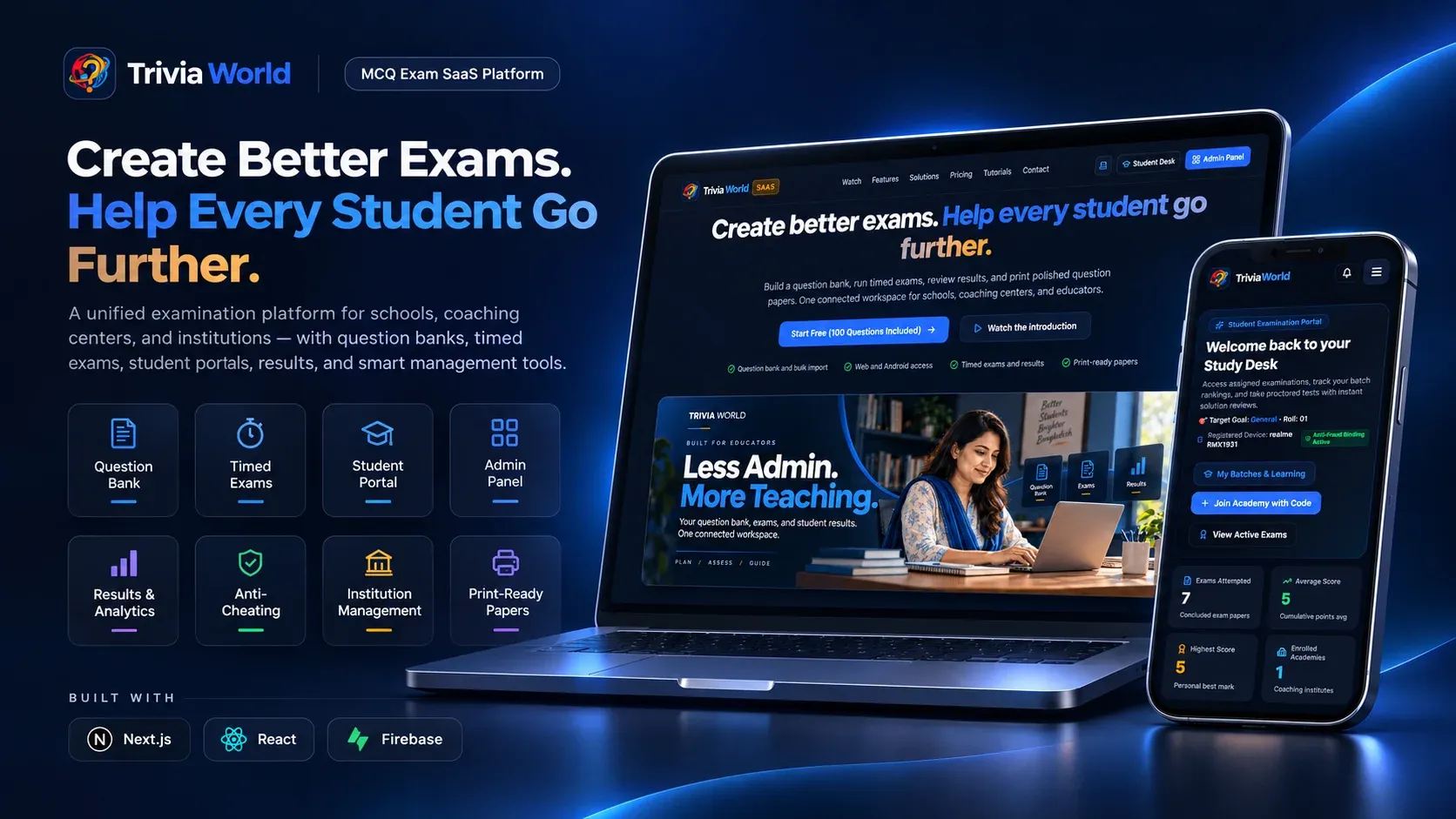
Trivia World is a comprehensive B2B2C examination and learning platform built to modernize how educational institutions manage online exams, question banks, students, and academic activities.Developed using Next.js, TypeScript, PostgreSQL, Prisma, and Kotlin with Jetpack Compose, the platform combines a responsive web application with a native Android experience.The system features a secure multi-tenant architecture with role-based access control, allowing multiple institutions to independently manage their teachers, students, batches, examinations, and subscriptions within a unified platform.Its advanced examination engine includes server-synchronized timers, automated scoring, negative marking, device restrictions, tab-switch detection, screenshot protection, and automatic submission to improve exam integrity.A key innovation is the Model Context Protocol (MCP) integration, enabling AI assistants such as Claude and Cursor to securely interact with institutional question banks, generate questions, organize educational content, and assist with exam creation.The platform also supports offline MCQ practice, personalized revision, real-time notifications, performance analytics, bilingual Bengali-English interfaces, printable question papers, and integrated payment gateways including bKash and Binance Pay.Designed with scalability, security, and user experience in mind, Trivia World brings institutional exam management and independent student learning together in one connected ecosystem.Key FeaturesMulti-Tenant SaaS Architecture: Independent institution management with role-based permissions and subscription plans.Secure Online Examination: Anti-cheating controls, device binding, server-based timers, automatic scoring, and detailed results.AI & MCP Integration: Secure AI-assisted question bank management, content generation, and exam preparation.Native Android Application: Built with Kotlin, Jetpack Compose, MVVM, and offline SQLite caching.Question Bank Management: Bulk importing, image optimization, subject categorization, and printable PDF exam papers.Student Learning Tools: Offline practice, bookmarks, mistake revision, mock tests, and performance tracking.Real-Time Communication: Firebase push notifications, exam announcements, and result updates.Payment & Subscription System: bKash, Binance Pay, manual payments, and flexible SaaS subscription management.Security & Authentication: JWT, Google OAuth, two-factor authentication, encrypted credentials, and audit logging.Bilingual Experience: Bengali and English support across web and Android platforms.
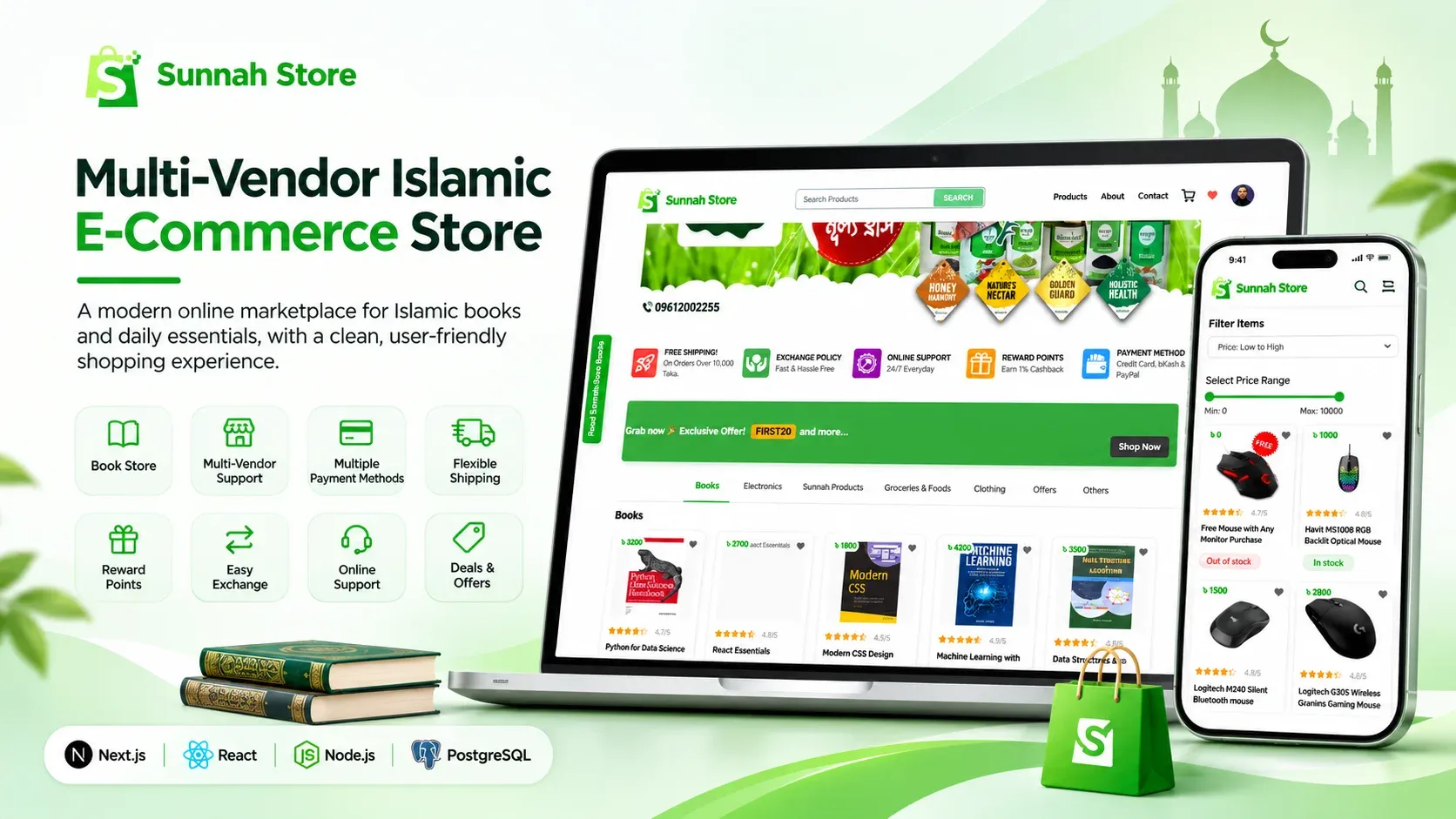
Project OverviewThe Sunnah Store is a full-featured e-commerce platform built with Next.js and MongoDB. The project was developed collaboratively, with significant work focused on solving complex product-management, browsing, filtering, and user-experience challenges.I worked as a major contributor alongside the original author, implementing new functionality, improving existing features, and solving several technical and usability issues across the platform.My Role and ContributionMy involvement went beyond isolated UI changes. I contributed to both frontend functionality and data-driven application logic, with particular attention to performance, responsive behavior, and smooth product discovery.Key areas I contributed to included:Product management and listing functionalityCategory-based product discovery and filteringResponsive interfaces for desktop and mobile devicesCheckout and shopping workflowsPerformance-focused filtering and user interactionsDebugging and improving existing application logicImplementing additional features as the platform evolvedPerformance-Focused Product FilteringOne notable feature I implemented was a dual-handle price range slider that allows customers to adjust minimum and maximum product prices from either side and immediately see the selected range.The main challenge was ensuring that a highly interactive control did not generate unnecessary database requests whenever the user moved a slider handle.I implemented debounced filtering logic, allowing the interface to remain responsive while controlling when the application executes the underlying product query. This reduced unnecessary repeated requests while preserving a smooth filtering experience for the customer.Product Discovery and User ExperienceThe platform includes structured product browsing and category-based filtering, helping customers narrow down the catalog and reach relevant products more efficiently.Throughout my contributions, I focused on keeping interactions practical across different screen sizes and ensuring that data-driven features remained responsive without introducing avoidable processing or query overhead.Technical ImplementationThe application uses Next.js for the web application and MongoDB for persistent product and commerce data.My work involved integrating frontend interactions with the application's existing data layer, implementing query-sensitive functionality, and improving components without disrupting established business workflows.Key Technical FocusNext.js application developmentMongoDB data integrationDebounced product filteringDynamic price-range selectionResponsive UI implementationProduct and category management workflowsPerformance-conscious database interactionsCross-device compatibilityTeam CollaborationThis was a team-developed project, not an individual build. I worked within the existing architecture and contributed substantially after the original author, extending functionality and resolving complex implementation challenges while keeping new work aligned with the project's existing requirements.The portfolio URL represents a demonstration version of the project. Production deployments are maintained separately and have been used by third parties for business purposes.OutcomeThe project demonstrates my ability to work effectively on an existing production-oriented codebase, understand established application logic, and implement substantial improvements rather than relying on rebuilding features from scratch.It particularly reflects experience with e-commerce workflows, interactive product filtering, database-backed functionality, performance optimization, responsive development, and collaborative software engineering.
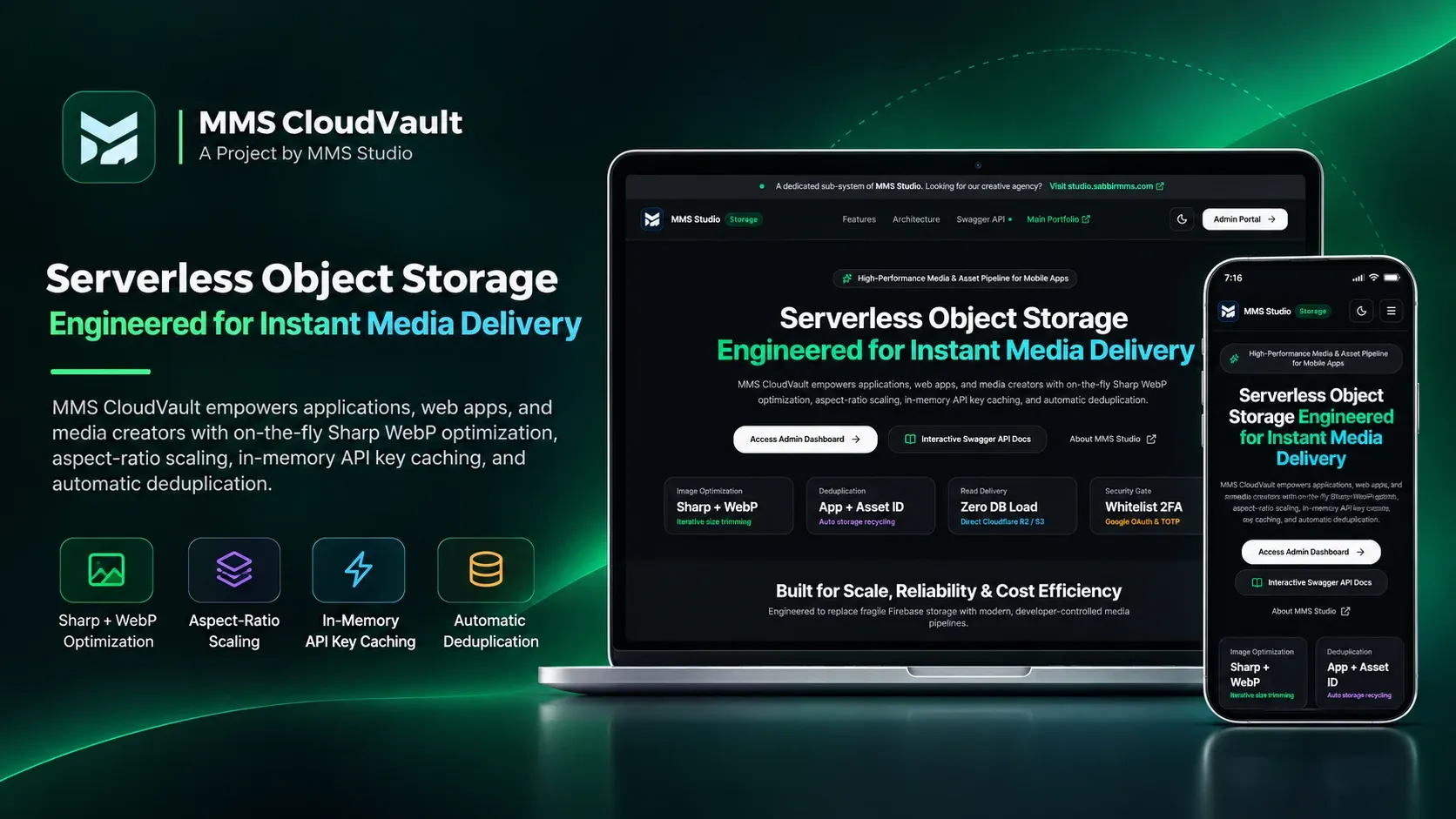
MMS CloudVault — High-Performance Serverless Media InfrastructureEngineered for Instant Media Delivery, Intelligent Storage Management, and Enterprise-Grade Security.Project OverviewMMS CloudVault is a high-performance media infrastructure and multi-cloud object storage management platform developed by MMS Studio. Built for modern web and mobile applications, it provides a centralized solution for uploading, optimizing, storing, securing, and delivering digital assets at scale.The platform combines serverless technologies, intelligent image processing, S3-compatible object storage, and advanced API security to create a reliable and cost-efficient media delivery pipeline.Unlike traditional file storage solutions, CloudVault is designed to automatically optimize media assets, prevent unnecessary storage duplication, reduce database operations, and deliver content directly through cloud storage and CDN infrastructure.The Engineering ChallengeModern applications frequently struggle with several infrastructure challenges:Large Media Files: Unoptimized images increase bandwidth consumption and slow down application loading.Storage Redundancy: Repeated uploads and outdated files create unnecessary storage costs.Database Overhead: Repeated database lookups during media delivery increase infrastructure load.Upload Limitations: Serverless request size restrictions complicate large media uploads.Security Vulnerabilities: Exposed API keys and unauthorized client requests can compromise storage infrastructure.Multi-Cloud Complexity: Managing multiple storage providers and application-specific buckets requires additional engineering.MMS CloudVault was designed to address these challenges through a unified, developer-controlled media infrastructure.Core Features & Architectural Innovations1. Intelligent Image Optimization PipelineBuilt with Sharp and native libvips, CloudVault automatically processes uploaded images before storing them.Converts supported image formats into optimized WebP assets.Automatically resizes images while preserving their original aspect ratio.Prevents unnecessary upscaling to maintain image quality.Uses adaptive compression to enforce configurable file-size limits.Generates BlurHash placeholders for progressive image loading.The optimization pipeline is designed to reduce image file sizes by approximately 60–85%, depending on the source image and compression settings.2. Multi-Cloud Object Storage ArchitectureCloudVault supports Cloudflare R2 and other S3-compatible object storage providers through a unified storage management layer.Key capabilities include:Dynamic storage bucket configuration.Application-specific storage routing.Separate image and audio storage destinations.Automatic bucket connectivity verification.Direct object storage delivery through CDN endpoints.Support for multiple storage accounts.This architecture reduces dependence on a single storage provider and allows applications to choose storage destinations based on their requirements.3. Automatic Asset Deduplication & ReplacementCloudVault implements an intelligent asset replacement engine using application IDs and unique asset identifiers.When an existing asset is updated, the system identifies the previous storage object, replaces its metadata, and removes the outdated physical file.This approach helps prevent orphaned assets, reduces unnecessary storage consumption, and maintains a consistent relationship between application records and stored media.4. High-Performance API Key CachingA dedicated in-memory LRU caching layer accelerates API key validation and reduces repeated database queries.The architecture includes:API key caching with automatic expiration.Fast in-memory validation.Cache invalidation when credentials change.Reduced database operations for repeated requests.The technical implementation documents approximately 0.03ms in-memory cache lookup performance, helping minimize authentication overhead for high-frequency API requests.5. Direct Media Delivery Without Database ReadsCloudVault separates media delivery from application database operations.Once an asset is uploaded and registered, clients can retrieve it directly through its cloud storage or CDN URL.This design reduces application server involvement during asset retrieval and avoids unnecessary database reads for standard media delivery.6. Secure Direct-to-Cloud UploadsCloudVault supports pre-signed S3 upload URLs, allowing compatible clients to transfer large files directly to object storage without passing the binary payload through the application server.The upload process includes:Authenticated requests for temporary upload URLs.Direct file transfer to the selected storage bucket.Secure asset registration and metadata management.Automatic replacement handling for existing assets.This is especially useful for larger audio assets and other media files that exceed conventional serverless request limits.7. Enterprise-Grade Authentication & SecuritySecurity is integrated across both the administrative dashboard and the media API.Administrative security:Google OAuth authentication using Auth.js.Strict email-based access whitelisting.Time-based one-time password (TOTP) two-factor authentication.Signed, HTTP-only session verification.Additional 2FA verification for sensitive bulk deletion operations.API and mobile security:Application-specific API key authentication.Firebase App Check integration.Google Play Integrity verification for supported Android clients.Cryptographic token signature validation.Unauthorized request rejection before processing media operations.These mechanisms provide multiple layers of protection against unauthorized access and abusive API requests.8. Modern Administrative Dashboard & Developer APIThe responsive administrative portal provides centralized control over storage infrastructure, application credentials, and media assets.Key capabilities include:Media gallery and asset management.Bulk asset selection and secure deletion.Application and API key management.Storage bucket configuration and connectivity testing.Detailed asset metadata and uploader attribution.Responsive dark and light themes.Interactive Swagger API documentation.OpenAPI-compatible REST endpoints and Postman collection support.The dashboard is designed to simplify complex storage operations without sacrificing developer control.Technology StackFrontend: Next.js 16, React 19, TypeScript, Tailwind CSS 4, LucideBackend & API: Next.js Route Handlers, Node.js, REST API, OpenAPI 3.0, Swagger UIDatabase: Serverless High-Availability PostgreSQL, Drizzle ORM, Composite IndexingCloud Storage: Cloudflare R2, AWS S3 SDK, Multi-Cloud S3-Compatible Object Storage, Pre-Signed Upload URLsMedia Processing: Sharp, libvips, WebP, BlurHash, Adaptive Image CompressionCaching: In-Memory LRU Cache, TTL-Based ExpirationAuthentication & Security: Auth.js, Google OAuth 2.0, TOTP 2FA, JWT, Firebase App Check, Google Play IntegrityPerformance & Engineering Highlights60–85% targeted image size reduction through optimized WebP processing, depending on input assets.Approximately 0.03ms in-memory API key lookup documented for the caching layer.Zero application database reads during direct media delivery using CDN and object storage URLs.Direct-to-cloud uploads to bypass application server payload limitations.Automatic asset replacement to reduce redundant storage.Application-specific multi-cloud routing for flexible infrastructure management.Layered security controls across administrative and client-facing operations.The project demonstrates practical experience in full-stack development, cloud infrastructure architecture, media processing, database optimization, API engineering, and application security.Designed, Architected & Developed by MMS StudioEngineering reliable infrastructure that makes media delivery faster, smarter, and more secure.
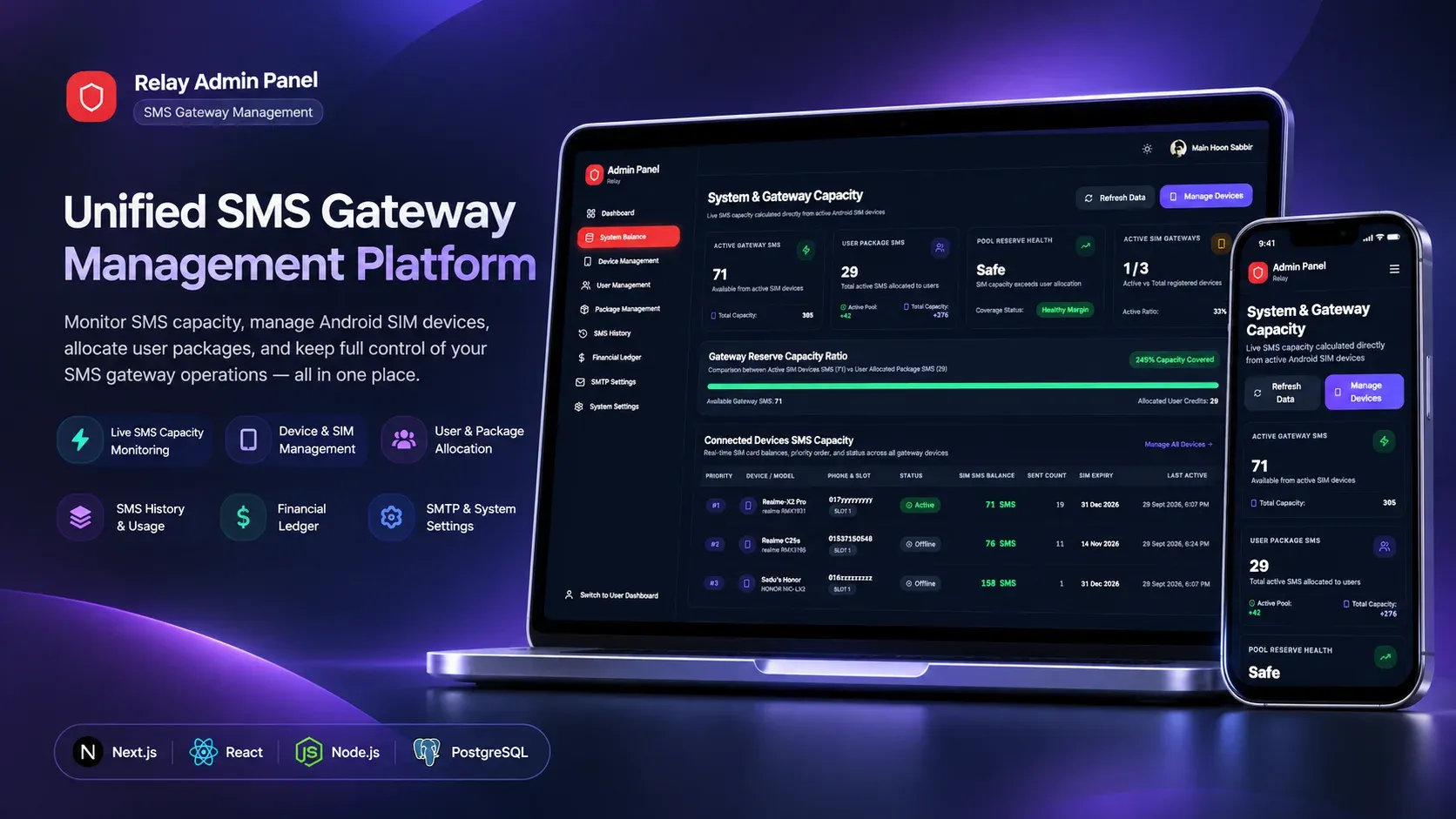
Relay is a full-stack SMS API and messaging platform built for developers, businesses, and service providers that need a centralized way to send, manage, and monitor SMS communications.The platform combines user-friendly messaging tools with developer-focused APIs. Users can send single or bulk SMS messages, review delivery history, manage their balance and packages, generate API keys, and access API documentation from a dedicated dashboard.Administrators receive complete operational control over users, SMS packages, system balances, connected gateway devices, SMTP configuration, website content, and platform settings.Key CapabilitiesSingle and bulk SMS messagingComplete messaging and transaction historySecure API-key generation and managementIntegrated developer API documentationSeparate user and administrator dashboardsUser, package, balance, and allocation managementSMS gateway device monitoringEmail verification and password recoveryGoogle OAuth and credentials-based authenticationAdministrative settings and SMTP configurationAutomated system-capacity reports through TelegramResponsive light and dark themesRole-based access and protected dashboard routesTechnical HighlightsAreaImplementationApplicationNext.js App Router, React and TypeScriptDatabasePostgreSQL with Prisma ORMUser InterfaceTailwind CSS, Radix UI and custom componentsAuthenticationCredentials, Google OAuth and email verificationMotionFramer Motion micro-interactionsReportingSecure REST endpoint with Telegram integrationPerformanceDatabase indexing, server-side caching and optimized data modelsArchitectureServer and Client Components with composed dashboard layoutsRelay was migrated from a Vite-based React application to a modern Next.js App Router architecture. The migration introduced server-side capabilities, structured routing, reusable layouts, optimized data access, and a more scalable foundation for future development.The result is a polished, developer-ready communication platform that brings messaging, API access, gateway monitoring, account management, and administrative operations into one cohesive system.
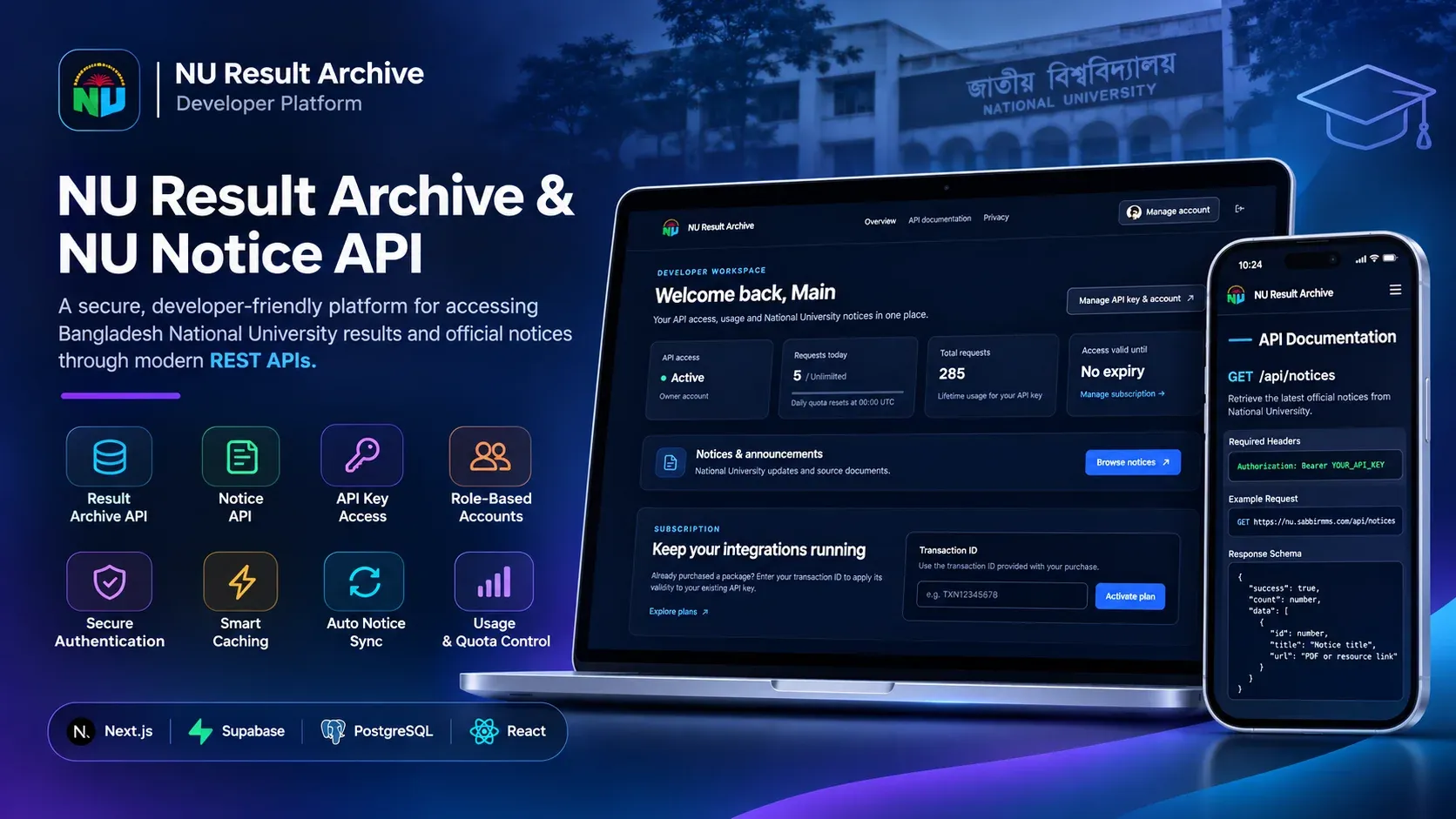
NU Result Archive & Notice API is an independent web platform designed to provide structured access to Bangladesh National University examination results and official notices through developer-friendly REST APIs.Built with Next.js App Router, React, Supabase PostgreSQL, and Supabase Authentication, the platform combines result archiving, notice management, API access control, account administration, and secure database operations into a centralized system.The project focuses on building a reliable backend infrastructure with efficient caching, verified authentication, strict permission boundaries, and transaction-safe data management.It operates independently and is not an official National University service.The Engineering ChallengeEducational data platforms must handle several important technical challenges:Data Accessibility: Providing structured API access to result archives and university notices.API Security: Preventing unauthorized requests, credential misuse, and quota bypassing.Database Protection: Restricting direct client access to sensitive tables and privileged operations.High Request Volume: Reducing repeated database operations through efficient caching.Account Management: Supporting different user roles with strictly controlled permissions.Data Consistency: Preventing duplicate records, incomplete updates, and conflicting transactions.Secure Authentication: Ensuring user account operations are performed only by verified account owners.The platform addresses these challenges using server-controlled database access, transactional PostgreSQL functions, authentication validation, and purpose-built API security.Core Features & Technical Implementation1. Developer-Friendly Results & Notice APIsThe platform provides REST endpoints for retrieving archived examination results and National University notices.Results APIRetrieve archived results using normalized source URLs.Submit structured examination results through authenticated API requests.Automatically update existing records using unique URL-based atomic upserts.Maintain consistent response structures for existing API consumers.Cache result responses for faster repeated access.Notices APIRetrieve available university notices through authenticated requests.Support automated notice ingestion from authorized sources.Replace the current notice collection through a single database transaction.Maintain sequential notice identifiers after successful synchronization.Roll back incomplete updates to protect data consistency.The API design maintains compatibility with supported legacy authentication headers while encouraging secure bearer-token usage.2. Secure API Key Authentication & Request QuotasA dedicated API key system controls access to result and notice endpoints.Key features include:Server-side API key validation.Account-specific request authorization.Daily request quota enforcement.UTC-based daily quota calculations.Atomic quota updates for concurrent requests.Protected administrative API key management.Separate authentication requirements for user accounts and data APIs.Quota validation is performed before serving cached responses, preventing caching from becoming a method of bypassing request limits.3. Supabase Authentication & Account OwnershipThe platform integrates Supabase Auth with Google sign-in to provide secure account authentication.Account-management endpoints require verified Supabase access tokens rather than trusting client-supplied user identifiers.Security measures include:Verified JWT-based session authentication.Server-validated account ownership.Idempotent API key creation for authenticated users.Protection against unauthorized role assignment.Separation of user session tokens and developer API keys.Private, non-cacheable responses for protected account endpoints.This prevents users from impersonating other accounts through modified request headers or identifiers.4. Role-Based Access Control & Administrative SecurityThe platform includes a structured permission system supporting Owner, Admin, and User roles.Administrative features include:Protected account listing and pagination.Search, sorting, and filtering by role and account status.API key status and expiration management.Secure account information updates.Database-enforced administrative authorization.Restricted role modification privileges.Protected owner accounts that cannot be demoted or deactivated through the account management API.Authorization is enforced at both the API and database transaction levels, reducing the risk of privilege escalation.5. Optimized Data Caching & PerformanceThe platform uses Next.js Data Cache to reduce repeated database operations and improve API response efficiency.Caching strategies include:120-second cache: University notice responses.900-second cache: Archived result responses, keyed by normalized URLs.Tag-based invalidation: Relevant cached content is invalidated immediately after successful mutations.Authorization-first execution: API key permissions and quotas are validated before cached content is accessed.This design balances response performance, data freshness, and secure API usage.6. Transaction-Safe Database ArchitecturePostgreSQL serves as the central database, with sensitive operations handled through server-controlled functions and transactional procedures.Important implementations include:Atomic result upserts based on unique URLs.Transactional notice synchronization.Automatic rollback when notice ingestion fails.Database-enforced role protection.Concurrency-safe request quota operations.Duplicate transaction prevention.Controlled account and API key creation.Direct database access is restricted for anonymous and ordinary authenticated clients. Privileged database operations execute through a server-only service client.This approach separates publicly accessible authentication features from sensitive database infrastructure.7. Secure Redemption & Transaction ProcessingThe platform includes a protected redemption workflow with account ownership verification and transaction safeguards.Security features include:Verified user authentication before redemption.Account ownership checks before contacting the transaction provider.Duplicate transaction hash detection.Prevention of concurrent pending redemption requests.Preservation of uncertain transactions for manual reconciliation.These safeguards reduce duplicate processing and help maintain consistent transaction states.8. SEO-Optimized Public WebsiteThe public-facing website is designed for accessibility, search engine discovery, and fast initial rendering.Implemented features include:Statically rendered landing pages and API documentation.Search engine-friendly page metadata.Canonical URLs and Open Graph tags.Twitter social preview metadata.Structured data using WebSite JSON-LD.Dynamic robots.txt and sitemap.xml routes.Bilingual educational content.Noindex protection for private account and login pages.Dedicated privacy policy and terms pages.Public content loads independently of user authentication, improving accessibility and search engine indexing.9. Responsive Dashboard & Account ManagementThe platform provides a responsive interface for users and administrators.Core dashboard capabilities include:Google-based account sign-in.Individual API key management.Account information and access status.Role-specific administration controls.Paginated account listing.Search and filtering options.Secure account editing.Expiration and account status management.The interface uses consistent layouts, status indicators, and accessible modal interactions to simplify administrative operations.